
Leaks and ground conditions
Can a Leaking Pipe Open a Sinkhole?
About a third of Lebanon County sits on limestone. The geology is nobody's fault, but the leaking pipe that feeds it is the half you can find and fix.
Published · 6 min read
Sinkholes get talked about around here as weather, something that happens to a road or a yard for reasons nobody controls. Half of that is fair. The other half is plumbing, and it is the half somebody can actually do something about.
The ground under the western county
About a third of Lebanon County sits on limestone and dolomite. Those rocks dissolve slowly in water that is even mildly acidic, which over a long enough period leaves cavities and channels underground. This is karst, and it is the reason the western side of the county has the sinkhole reputation it has.
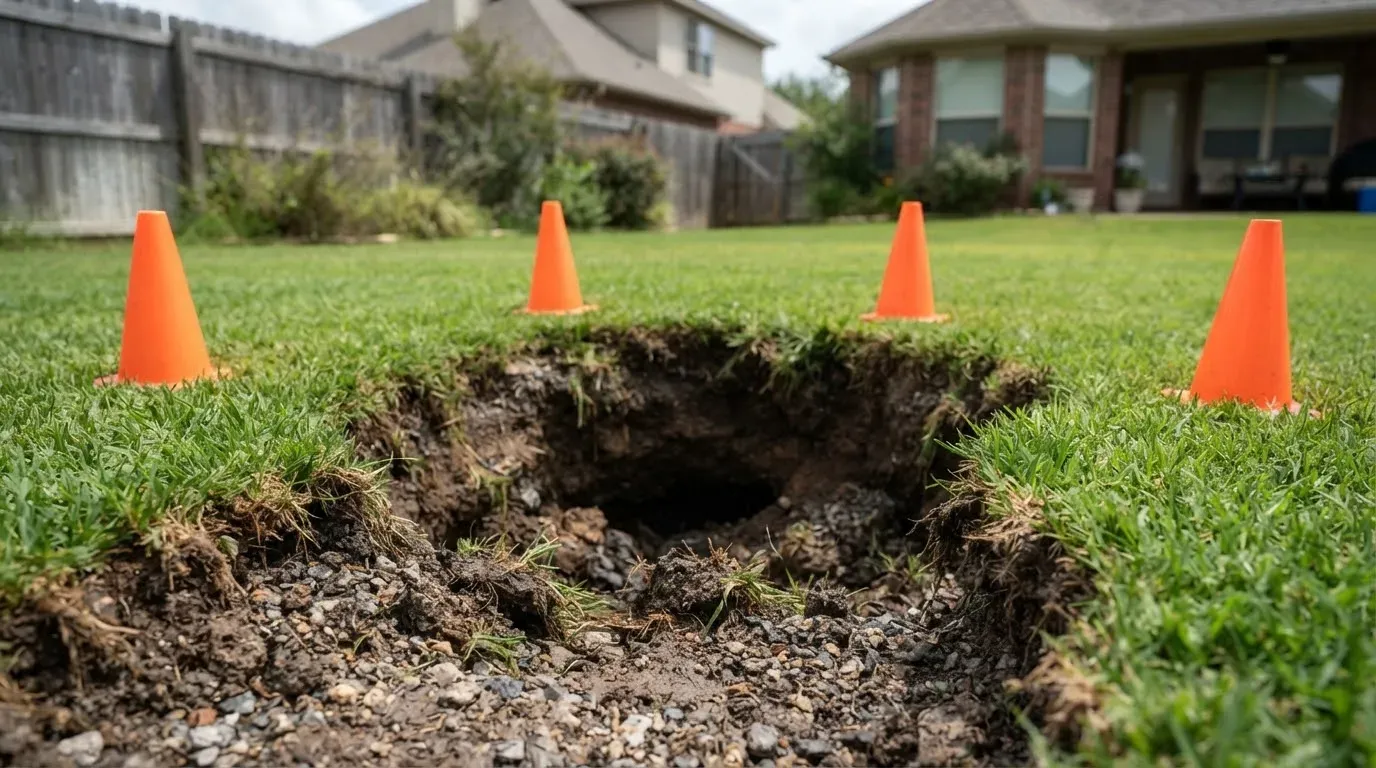
What opens at the surface is usually not the cavity itself. It is the soil above it. Water moving down through the ground carries fine material into the voids in the rock, grain by grain, and a space gradually forms under the surface while the top still looks intact. It holds until it does not. That is why sinkholes seem sudden when the process behind them took years.
Geology on its own is enough to do this. It has been doing it here for a very long time.
What a leaking line adds
The part worth a homeowner’s attention came up in August 2026, when a geologist presented to Palmyra Borough Council on subsurface conditions. Limestone was named as the first cause of sinkholes in the borough. Leaking utility lines, water, sanitary sewer and stormwater, came second, and not distantly.
The mechanism is straightforward once you see it. A buried pipe with a leak is a continuous supply of water at one fixed point underground, running regardless of weather. Rain is seasonal and spread out. A leaking service line or a cracked lateral is a steady stream into the same spot, day and night, for as long as it goes unnoticed. It washes soil into the rock faster than rainfall ever would, and it does it in one concentrated place rather than across the whole yard.
So the pipe does not create the conditions. It accelerates them, and it decides where.
This cuts the other way too. A sewer lateral leaking underground is often not noticed from inside the house at all, because the fixtures still drain. The leak is out of sight, out of mind, and doing its work the entire time.
The signs in a yard
Most of what points at a buried leak is on the surface, and it is easy to overlook because none of it looks like plumbing.
A strip of grass that stays green and soft when the rest of the lawn is dry, particularly in a line running toward the street. Ground that has settled around a cleanout, a meter pit or along the path a pipe is known to take. A dip in a lawn or driveway that keeps needing topped up. Paving slabs or a patio section that has started tilting. A sewage smell outdoors while everything indoors behaves normally. And on the supply side, a water bill that has climbed with no change in how the household uses water.
Any one of those on limestone ground is worth looking at properly rather than watching.
Which part is a plumbing question
It is worth being clear about the division, because it saves confusion.
What the ground is doing is a geological question. If a hole has already opened on your property, its extent and stability are not something a plumber determines, and nobody should fill it in and assume that is the end of it.
Whether a pipe is feeding it is a plumbing question, and it has a definite answer. A meter test establishes whether water is escaping on the supply side. A camera run down the lateral shows whether the waste line is cracked, offset or discharging into the ground, and how far out the fault sits. Those two checks either find a leak or rule one out, and both are short.
The reason to do it early is simple arithmetic. Locating and repairing a leaking line is ordinary work. Dealing with the same line after the ground above it has gone is excavation, restoration and a much longer conversation.
If you have a soft patch, a settling spot or a bill that climbed for no reason on a Palmyra or western county property, call us and we’ll get a licensed plumber out to find out where the water is going.