
Buying and selling
Scope the Sewer Before You Buy That Older House
The sewer lateral is the biggest repair in a house that a home inspection does not cover. On older property it is worth putting a camera down it before you close, not after.
Published · 6 min read
You have had the house inspected. The roof got looked at, the furnace got looked at, the electrical panel got looked at. The single biggest thing that can go wrong under that property did not get looked at, because it is buried and a home inspection does not cover it.
The one thing the inspection skips
A standard home inspection is a visual inspection. The inspector reports on what can be seen and operated on the day. The sewer lateral, the pipe carrying waste from the house out to the public main or to a tank, runs underground from the foundation to the street. None of it is visible.
So the report comes back clean on drains because the fixtures drained during the visit. That is a true statement about the fixtures and it says nothing about the sixty feet of pipe between the house and the main.
A lateral in poor condition is not a small repair. It involves excavation, often across a yard, sometimes under a driveway or a sidewalk, with municipal permits attached. It is the kind of number that changes whether a house was a good buy.
What the camera actually shows
A camera inspection is a short job. The camera goes in at a cleanout, or through a pulled toilet if the property has no accessible cleanout, and runs the length of the line while you watch the screen.
What comes back is specific. The material the pipe is made of. Its condition along the run. Roots, and whether they are a few strands at a joint or a mass filling the bore. Cracks, offsets where two sections have shifted apart, and bellies, which are sags holding standing water. Blockages, and whether they are soft waste or something structural. And the distance to any of it, which is what decides whether a repair is a single dig or a full replacement. Sewer line repair covers what each of those involves.
That last detail matters more than people expect. Knowing a defect sits eleven feet from the house is a different conversation from knowing it sits fifty feet out under a mature tree.
Clay, cast iron and Orangeburg
Older housing here means older materials, and they fail in distinct ways.
Clay was standard for a long time and comes in short sections, which means a joint every few feet. Clay itself does not rot, but every one of those joints is a way in for roots, and roots is what you usually find.
Cast iron rusts from the inside out. The bore roughens as it goes, catching anything passing through, which is why a cast iron line that has started to go blocks repeatedly in the same place no matter how often it is cleared.
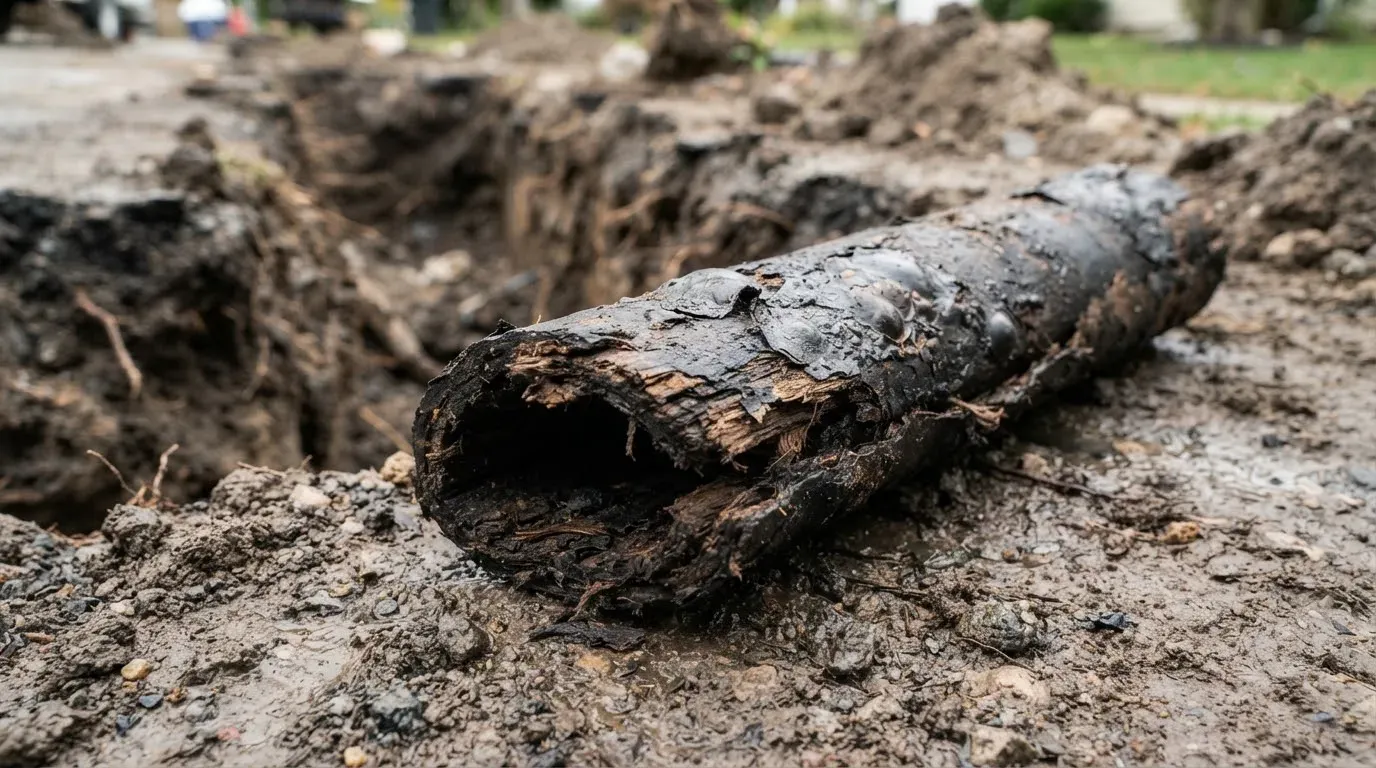
Orangeburg is the one worth knowing by name. It is a bituminous fiber pipe, essentially layers of wood pulp and tar, used widely in the middle of the last century because it was cheap and light. It softens with age and deforms out of round, and once it has started there is no repairing it in place. Finding Orangeburg on a camera run is finding a replacement, and it is far better to find it before closing than two winters later.
When it is worth doing
Anything built before roughly 1970 is the straightforward case, and the older the property the stronger the argument.
There are other triggers regardless of age. Mature trees between the house and the street, because roots go where the moisture is. Any history of backups the seller mentions, or any sign of one in the basement. A property on limestone ground in the western part of the county, where a leaking lateral does not only drain badly but washes soil into the rock and contributes to sinkholes. And a house that has stood empty for a while, because a line that has not been used does not announce its problems.

What to do with what you find
A clean run is worth the morning on its own. You stop wondering.
If the footage shows something, you have options you would not have had afterwards. Roots at a joint with sound pipe around them is a maintenance item, not a crisis, and knowing about it means you can plan for it. Structural failure, a collapse, a serious belly or Orangeburg anywhere in the run is something to raise before you sign, while it is still part of the deal rather than your repair.
Either way you own the house knowing what is under the yard, which is the whole point.
Buying an older place in Lebanon County and want the lateral looked at before you commit? Call us with the address and roughly when the house was built, and we will tell you what the run involves.